Roadmap for a Successful AI Project


I delivered a two-day AI/ML Essentials course in June 2026 focused on helping participants identify, plan, and execute successful AI/ML projects. Knowing that AI projects rarely fail because of the technology itself, I concentrated on the fundamentals that actually determine success: domain knowledge, data hygiene, selecting the right tools, and critical thinking. You can download the slides from the course (minus the active learning components)
.
The programme is built around hands-on exercises, culminating in an AI project brief complete with a cost-benefit analysis. This isn't a fictional case study. It's a practical strategy you could put in front of your board. The project brief template is included in the slides.

If you're unsure whether your organisation has the bench strength to run an AI pilot, that's covered too. AI transformation is an organisation-wide journey. Leaders can't simply hand it to IT and expect good results, and IT can't succeed in isolation without continuous input and feedback from business stakeholders.
We also examine the practical questions that often determine whether a project succeeds or stalls. Who owns data governance? How do you address compliance, privacy, and security? If your project competency checklist reveals gaps, how do you evaluate and hire external consultants with confidence?
I teach a simple three-gate test to determine whether a problem is even suitable for AI or machine learning.
First, are there meaningful patterns that repeat?
Second, do you have the data? Exploratory Data Analysis (EDA) may be the least glamorous task in an AI project, but it is often the most important. Do you have enough data? Is it clean, representative of the real world, and reasonably balanced?
Finally, what is the cost of being wrong? Some AI mistakes are inconvenient. Others are expensive, unsafe, or legally problematic. Understanding that distinction should shape every project.
Participants are encouraged to bring a real business problem to work on during the course. If they don't have one, I've developed fifteen business scenarios drawn from industries that are important to Singapore, allowing everyone to apply the framework to realistic situations.

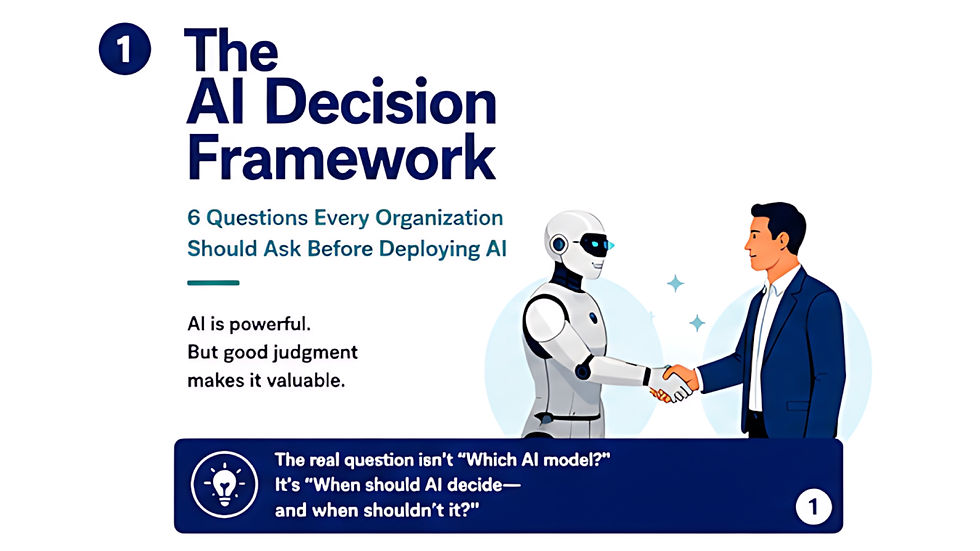
In a future that has already arrived, where everyone has access to the same AI tools, the real differentiator is how people think. Technology is increasingly becoming a commodity. Sound judgement, disciplined problem-solving, and critical thinking are what separate successful AI projects from those that fail.


Comments