AI Skills Alone Won't Save Your Business: Judgment Is the Real Competitive Advantage

Executive Summary
Key Takeaways
Judgment, Not Just Technical Skills: Technical AI capabilities are becoming commoditized. True competitive advantage belongs to organizations with leaders who know where AI should—and shouldn't—be used.
Start with Purpose, Not Models: Effective AI strategy starts with human empathy and business problems ("What routine work is holding us back?"), rather than chasing the newest AI model.
Play to Distinct Strengths:
AI Excels At: Repetitive, rules-based, data-rich, high-volume, and time-sensitive tasks.
Humans Remain Indispensable For: Ethics, empathy, real-world context, cultural nuance, and ultimate accountability.
Intentional Oversight Architecture: Human involvement must be designed along a spectrum based on risk:
Human-in-the-Loop (High stakes: AI recommends $\rightarrow$ Human decides)
Human-on-the-Loop (Medium risk: AI executes $\rightarrow$ Human supervises)
Human-out-of-the-Loop (Low risk: Fully autonomous)
Leadership Defines Demand: Training creates skill supply, but AI-literate leaders are required to identify high-impact problems, redesign workflows, and set governance guardrails to capture real value.
Artificial intelligence has become the corporate equivalent of the gold rush. Every week there's a new model, a new AI agent, a new productivity tool promising to transform the way we work. Governments are investing billions. Companies are launching AI initiatives.
Employees are rushing to learn prompt engineering, Python, machine learning, and every new acronym that appears on LinkedIn.
But there is an uncomfortable truth that doesn't receive enough attention.
Skills alone are not enough.
The organizations that will benefit most from AI won't necessarily have the most AI engineers. They'll have leaders who understand where AI should,and shouldn't,be used. They'll build cultures that value judgment as much as technical capability. And they'll create demand for responsible AI instead of chasing technology for technology's sake.
The nine-part AI Decision Framework presented here isn't simply about selecting AI technologies. It's about developing organizational judgment.
The Wrong Question
Most organizations begin with the wrong question.
"Which AI model should we use?"
Or perhaps: "Is ChatGPT, Gemini, Kimi, or Qwen better?"
These questions focus on technology rather than business problems.
The better questions are much simpler.
“What decisions define our success, and what routine work is holding us back from reaching it?"
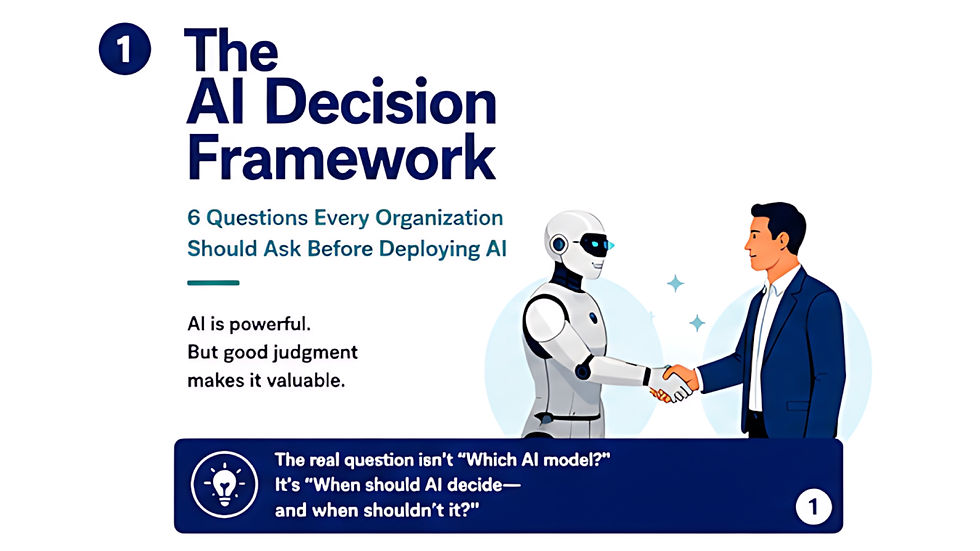
Technology should always follow purpose.
Just as no carpenter begins by asking which hammer is most fashionable, organizations shouldn't begin AI projects by selecting the newest model. They should start with empathy, focusing first on the human beings at the heart of the problem.
Good AI strategy starts with empathy, because solving genuine human problems is the fastest path to meaningful business value.
AI Isn't One Thing
Many executives still talk about AI as though it were a single technology.
It isn't.

Machine learning predicts patterns from historical data. Natural language models understand and generate text. Computer vision interprets images and video. Multimodal systems combine several capabilities into a single solution.
Choosing the wrong technology is often worse than choosing no technology at all.
A company wanting to forecast customer churn requires different AI than a hospital analysing medical images or a retailer automating customer support.
This is why AI literacy matters beyond technical teams.
Decision-makers need enough understanding to ask the right questions and challenge simplistic solutions.
Just Because AI Can Doesn't Mean AI Should
Perhaps the most important lesson in the framework is distinguishing between tasks AI performs well and those where humans remain indispensable.

Where AI Excels
AI thrives in environments with high structure, predictable patterns, and immense scale. It processes information at a velocity no human can match, making it an ideal engine for operational efficiency.
Repetitive
Machines do not suffer from fatigue, boredom, or distraction. When a task requires performing the exact same steps over and over,such as data entry, invoice processing, or basic ticket routing,AI maintains 100% operational consistency without quality degradation.
The Value: It frees human workers from low-engagement, soul-crushing routine work.
Rules-Based
Algorithms operate strictly within the parameters and logic trees they are given. Whether applying tax compliance rules, verifying form submission requirements, or checking code against formatting standards, AI evaluates input against predefined logic flawlessly.
The Value: Eliminates human error caused by oversight, memory gaps, or compliance fatigue.
Data-Rich
Human cognition caps out when processing massive datasets, but AI gains accuracy and nuance as data grows. It can analyze millions of customer transactions, sensor signals, or historical records simultaneously to uncover subtle patterns, correlations, and anomalies.
The Value: Turns unstructured "data noise" into actionable, predictive intelligence.
High Volume
Scaling human teams linearly with workload growth is expensive and slow. AI handles exponential volume spikes,like millions of simultaneous website visits or thousands of customer queries during a product launch,without needing additional headcount or suffering performance bottlenecks.
The Value: Unlocks effortless scalability at minimal incremental cost.
Speed-Sensitive
Certain decisions lose their value in milliseconds. In high-frequency trading, fraud detection at a point-of-sale terminal, or real-time cyber threat mitigation, waiting for a human to review the event renders the response useless.
The Value: Delivers real-time execution where human reaction speed is inherently too slow.
Where Humans Remain Indispensable
While AI excels at calculation and processing, humans excel at judgment, moral reasoning, and relational connection (connecting the dots). These dimensions require capabilities that cannot be reduced to statistical probability.
Ethics
AI models do not possess moral principles; they only mirror the data they were trained on, which often carries implicit historical bias. Evaluating whether an outcome is fair, just, or morally sound requires human conscience and principled decision-making.
The Value: Prevents algorithmic bias from harming individuals, communities, or corporate integrity.
Empathy
AI can simulate polite language, but it cannot genuinely feel shared human experience. In sensitive situations, such as delivering bad medical news, handling a distressed client, or managing a workplace conflict, genuine emotional resonance and compassion are irreducibly human.
The Value: Builds real trust, emotional safety, and lasting human connection.
Context
AI analyzes data within a closed environment, but real-world decisions happen inside dynamic, ambiguous ecosystems. Humans intuitively factor in unstated motives, subtle body language, historical nuances, and unspoken organizational politics that fall outside an AI’s training window.
The Value: Prevents tone-deaf or technically "correct" decisions that fail in the real world.
Cultural Understanding
Humor, nuance, idioms, symbolism, and social norms vary wildly across regions, demographics, and generations. What is inspiring in one culture may be offensive in another. Humans navigate these unwritten social codes naturally.
The Value: Protects brands from cultural missteps and ensures messaging resonates authentically with diverse audiences.
Responsibility
An algorithm cannot be held legally or morally accountable for its mistakes. When an AI system fails, whether in medical diagnosis, loan approval, or autonomous navigation, a human leader must take ownership of the outcome, answer to stakeholders, and remediate the harm.
The Value: Ensures clear governance, accountability, and legal liability.
Unfortunately, organizations often reverse these priorities.
Many companies still require humans to perform repetitive administrative work while experimenting with AI in areas involving hiring, lending, medical advice, or legal interpretation.
That is exactly backwards.
AI should remove routine work so humans can spend more time applying uniquely human judgment.
Human Oversight Is a Design Decision
One of the biggest misconceptions surrounding AI deployment is that automation is an all-or-nothing choice, that implementing AI automatically means replacing human effort entirely. In reality, human involvement exists along a spectrum, and determining where a given task falls on that spectrum is one of the most critical strategic choices an organization can make.
Designing human oversight isn't an afterthought or a technical glitch to be worked around; it is a deliberate architectural and governance decision.

The Three Models of Human-AI Collaboration
Rather than viewing AI as a total replacement for human staff, leaders must design workflows around three primary models of human-machine partnership:
1. "Human-in-the-Loop" (AI Recommends -> Human Decides)
How It Works: The AI acts as an analytical advisor, processing data and generating insights, options, or predictions. However, a human expert retains sole authority to execute the final decision.
Where It Belongs: High-stakes, high-consequence environments where errors carry significant human, legal, or financial costs, such as medical diagnoses, capital lending approvals, judicial sentencing recommendations, or strategic hiring decisions.
The Strategic Benefit: Leverages the raw processing power of machine learning while preserving human accountability, ethics, and contextual judgment.
2. "Human-on-the-Loop" (AI Executes -> Human Supervises)
How It Works: The AI carries out routine, high-volume tasks autonomously under the real-time or periodic supervision of a human operator. The human intervenes only when anomalies occur, confidence thresholds drop, or edge cases arise.
Where It Belongs: Medium-risk operational workflows, such as automated customer support ticket routing, fraud detection flagging, automated content moderation, or supply chain inventory adjustments.
The Strategic Benefit: Unlocks massive scale and velocity without sacrificing safety, allowing a single human supervisor to oversee thousands of automated operations effectively.
3. "Human-out-of-the-Loop" (Fully Autonomous)
How It Works: The AI system senses, decides, and executes independently without requiring human review or intervention.
Where It Belongs: Strictly limited to carefully validated, low-risk, speed-sensitive environments, such as email spam filtering, high-frequency trade execution within strict algorithmic guardrails, or dynamic website asset caching.
The Strategic Benefit: Eliminates latency entirely where human reaction time is inherently too slow or where the cost of a minor error is negligible.
Why Oversight Is a Governance Decision, Not a Technical One
Engineers build AI capabilities, but leadership must define AI parameters. Determining the right degree of human oversight requires balancing four core business dimensions:
Risk Appetite: How much operational or financial exposure can the company tolerate if an algorithmic error occurs?
Regulatory & Legal Obligations: What compliance frameworks (e.g., GDPR, EU AI Act, industry regulations) mandate human review, explainability, or audit trails?
Customer Expectations: Will users feel alienated or betrayed if they realize a human wasn't involved in a decision affecting their lives or accounts?
Ethical Responsibilities: Does automated decision-making introduce potential systemic bias or unfair outcomes that require human moral reasoning to detect and remediate?
Key Takeaway for Leaders
Automated capability does not dictate organizational permissions. Just because an AI can operate independently does not mean it should. Architecting the boundary between human judgment and algorithmic execution is fundamentally a leadership duty, one that protects the organization's reputation, values, and long-term value.
Confidence Is Not Certainty
Modern AI systems routinely report confidence scores, but many leaders misunderstand what those numbers actually mean. High confidence does not guarantee correctness, and low confidence does not automatically imply failure.
Instead, confidence scores should dictate workflow design, specifically, how much human review is required before action is taken.
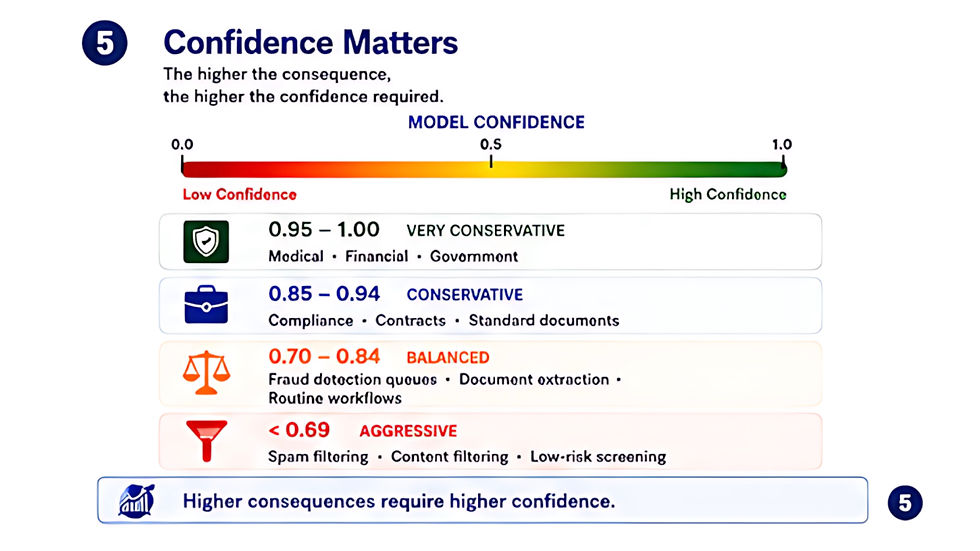
A spam filter can tolerate occasional mistakes with minimal fallout. A financial recommendation, a medical diagnosis, or a hiring decision affecting someone's livelihood cannot. As the real-world consequences of an error escalate, the confidence threshold required for autonomous execution must rise with them.
Responsible organizations recognize a fundamental rule of AI governance: accuracy requirements must always scale with the cost of being wrong.
Knowing When Not to Answer
One of the most valuable capabilities when using any AI is something surprisingly simple: knowing when to stop.

A mature AI strategy requires systems that can reliably recognize boundaries, specifically:
High Uncertainty: Recognizing when confidence drops below acceptable thresholds.
Insufficient Evidence: Admitting when required context or supporting data is missing.
Policy Boundaries: Halting execution when safety, compliance, or ethical limits are reached.
Human Escalation: Seamlessly handing off execution to a human expert when a situation demands nuanced judgment.
Ironically, this operational restraint often creates far more trust than flashy demonstrations of capability. Stakeholders rarely expect perfection from technology, but they do expect honesty and trasparency.
Organizations should therefore measure AI maturity not only by how often a model answers correctly, but by how reliably it recognizes its own limitations.
Good Judgment Cannot Be Automated

The final pillar of the framework identifies six foundational elements of good judgment:
Continuous Learning: Adapting to evolving conditions beyond static training data.
Trust & Experience: Building credibility and leveraging hard-earned real-world intuition.
Detachment: Remaining objective and unbiased when evaluating critical outcomes.
Considering Alternatives: Weighing non-obvious choices and unintended consequences.
Effective Delivery: Communicating decisions with nuance, authority, and accountability.
Notice what these elements have in common: none of them are programming languages, prompt engineering techniques, or GPU clusters.
These are human leadership capabilities. They develop over years of experience, reflection, collaboration, and disciplined decision-making.
While AI can rapidly process and synthesize information, it cannot replace wisdom. Genuine wisdom comes from integrating knowledge with values, context, uncertainty, and responsibility, qualities no algorithm can automate.
Skills Create Supply. Leadership Creates Demand.
Today, there is an immense global focus on AI skills, governments fund training courses, universities launch specialized degrees, and professionals rush to earn certifications. While all of these initiatives are valuable, they only address one side of the equation: skills create supply, but they do not automatically create demand.
Without strong leadership vision, technical capabilities sit idle. Technical skills remain severely underutilized when key organizational bottlenecks persist:
Executives cannot identify high-impact business problems to solve.
Managers cannot redesign legacy workflows around new capabilities.
Boards cannot establish sound governance and risk boundaries.
Customers do not trust or embrace AI-enabled services.
Ultimately, the greatest bottleneck facing modern organizations isn't a shortage of AI engineers; it is a shortage of AI-literate leaders. We need leaders who understand technology deeply enough to make informed strategic decisions without needing to build the models themselves.
Leaders who understand technology well enough to make informed decisions without needing to become machine learning specialists themselves.
Building an AI-Ready Organization

Becoming an AI-ready organization requires far more than technical expertise. True readiness is built across three distinct layers of the business:
Empowered Talent: Requires informed executives who set vision, educated middle managers who redesign workflows, and frontline employees empowered to use tools safely.
Governance & Trust: Demands clear governance frameworks, deeply held ethical principles, and non-negotiable customer trust.
Culture & Mindset: Fosters continuous learning, a willingness to experiment, and the discipline to say "not yet" when a technology or use case isn't ready.
Technology alone cannot create these conditions. People do. Leadership does. Culture does.
A Positive Future
The public discourse around AI often swings between two dramatic extremes: one predicting universal prosperity, the other predicting widespread job loss. The reality will almost certainly be far more nuanced. While AI will automate routine tasks, history shows that transformative technologies rarely eliminate the need for human capability, they simply shift which capabilities matter most.
The future belongs to people who combine technical literacy with sound judgment:
Leaders who ask better questions before chasing newer technology.
Organizations that view AI not as a human replacement, but as a force multiplier for better decision-making.
In the years ahead, competitive advantage will not come from owning the latest AI model, those tools are becoming accessible commodity inputs for everyone. The enduring advantage will come from an organizational culture that knows when to trust AI, when to challenge it, and when human judgment must lead.


Comments