Unveiling the Secrets: A Sneak Peek Inside a Foundational AI Course
- Tat Yuen

- Apr 24, 2024
- 4 min read
Singapore as an AI Talent Hub
It was announced late last year that Singapore is targeting to more than tripling its AI workforce to 15,000 in the next three to five years.
And just like a business, you can do this in two ways. One is to develop talent in Singapore through education and training and second is to hire from abroad. But competition for AI-related skills is heated and those who can offer more attractive compensation and working environments will get the lion's share of top talent.
How You Can Get In On It
I decided to get some hands-experience last year when I took a self-paced online course offered by AISingapore.org. AI Singapore is a national program aimed at accelerating the adoption of artificial intelligence (AI) in the country's industries and society. It offers online courses as well as an apprenticeship program to develop talent and place them directly into industry.
The online course I took was quite thorough but it's the floor when it comes to qualifying for paid apprenticeship program. If you are interested in getting into AI then this online course may be a good way to get started. Subsidies apply so it's also a cheap way. All you need is curiosity, an open mind, a computer, internet access, and time.
AI4I - Foundations in AI
There is a prerequisite course but it's short and it's free. If you want a more in depth introduction to AI, I suggest taking Prof Andrew Ng's AI for Everyone on Coursera.
The course is comprised of 35 modules and an estimate 140 hours to complete. I could already program in Python and took some other AI courses and it took me more than 140 hours. And that's because self-directed learners will invariably do additional reading and try related exercises on their own. I was not working and was able to complete the course in about four months.
The courseware is mostly curated content from Datacamp and the cost of this course includes a voucher for a Datacamp user account. In my reflection after completing the course, I decided to gather some statistics and here's what I found:

Not to worry. Though most of the exercises are coding exercises, some are MCQs. Besides, the coding exercises are short and it's fill in the blanks.
The thirty five compulsory modules are grouped as shown.


Note that some modules were created by AI Singapore and these are rather lengthy and insighful exercises. One module, DSPM-2 is outdated and not worthwhile in MHO.
Deeper Dive
Let's take a deeper dive into the lessons so you can get an idea of what to expect. Let's take a look at Machine Learning with Tree-based Model in Python under Supervised Learning.

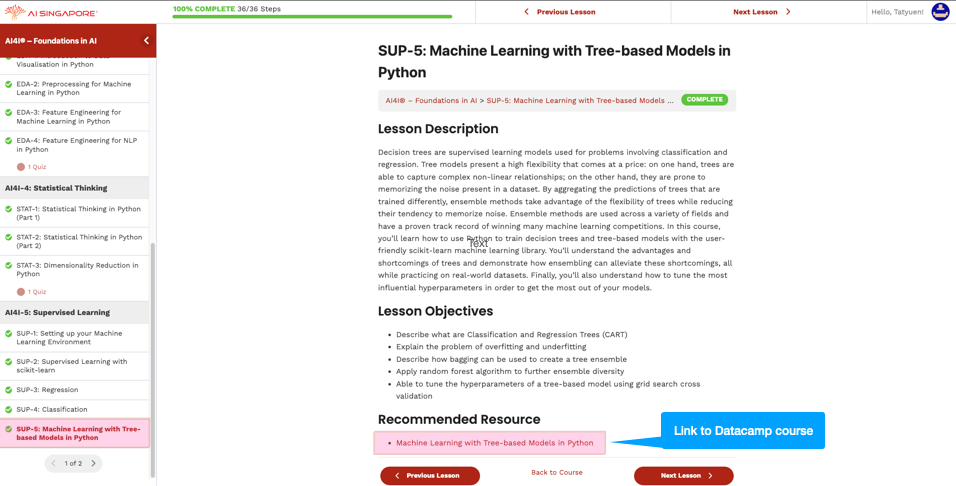
The link in the Recommended Resources Section will direct the learner to the course in Datacamp.

You can download the datasets and have a copy of the coding exercises on your local machine or in Google Colab, if you have an account. And your capstone project will require using Google Colab unless your home computer has sufficient resources to perform the training.
Now lets see the chapter on Classification and Regression Trees
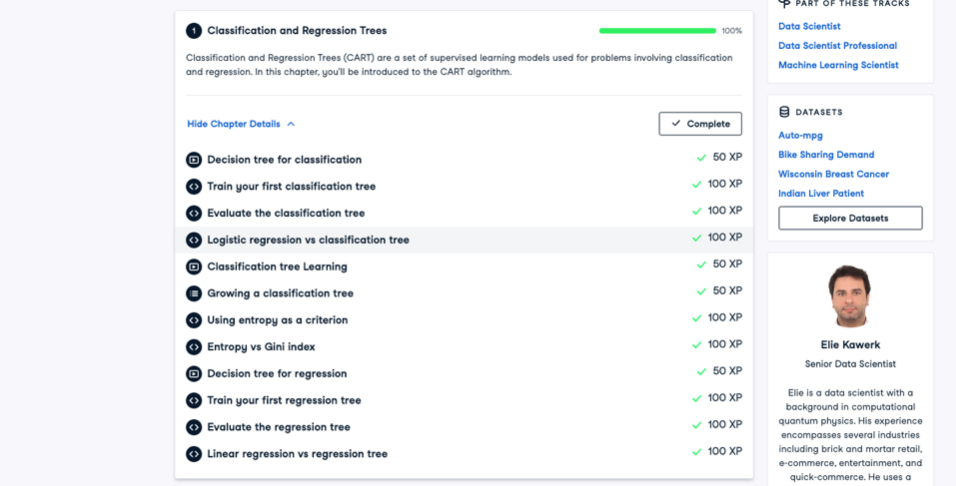
The chapter details will show you all the exercises you will need to complete for this chapter. The icons are representative of questions about videos, readings, and coding exercises.
The Datacamp course is comprised of 5 chapters as seen here.

If your English is not the best, no worries, you can read the transcripts. You can also download the videos to view during your commute. I like to watch videos at 1.25x speed but that's up to you. This chapter has 5 sections but not all section have quizes or coding exercises.
Coding Exercises
The coding exercise for Logistic regression vs classification tree looks like this:

You can see the results of your code as well as error messages in the bottom right quadrant.
There's AI support if needed to provide hints. Each time you ask for a hint, the number of points you are awarded for this exercise goes down an increment. You get no points if you ask to see the solution. This happened to me a few times, because my coding was a bit different than the "fill in the blanks" example that I used in JuypiterLab environment.
So there you have it. And here's my certification of completion and not attainment because I did not get assessed for competency, which is the next step.

I recommend you install your own version of juypiter notebook or jupyterlab from the start. You can download the datasets and code from Datacamp and have it for posterity. I did find that in some cases, a dataset here and there were not available. And some glitches like when they indicate that a library was imported for you when it's not. No big deal there.
Reflection
I highly recommend this course as the learner will get hands-on coding experience and gain valuable intuition through the many plots. The content and instructional methods were of the highest quality delivered by professionals in their field. And they were delivered in short bursts followed by exercises to test and reinforce learning. There were many real-world examples used in the exercises so that learner is exposed to varied applications of AI.
I would suggest that anyone consider taking this course to become data literate first followed by data fluency. And learning some basic statistics will help in the later part of the course. You won't need to know a lot of math except for some matrix multiplication. If you know what partial differential equations are, then you are definitely primed.
Got for it folks and let me know what you are thinking in regards to learning AI.

Comments